THE SHORT ANSWER
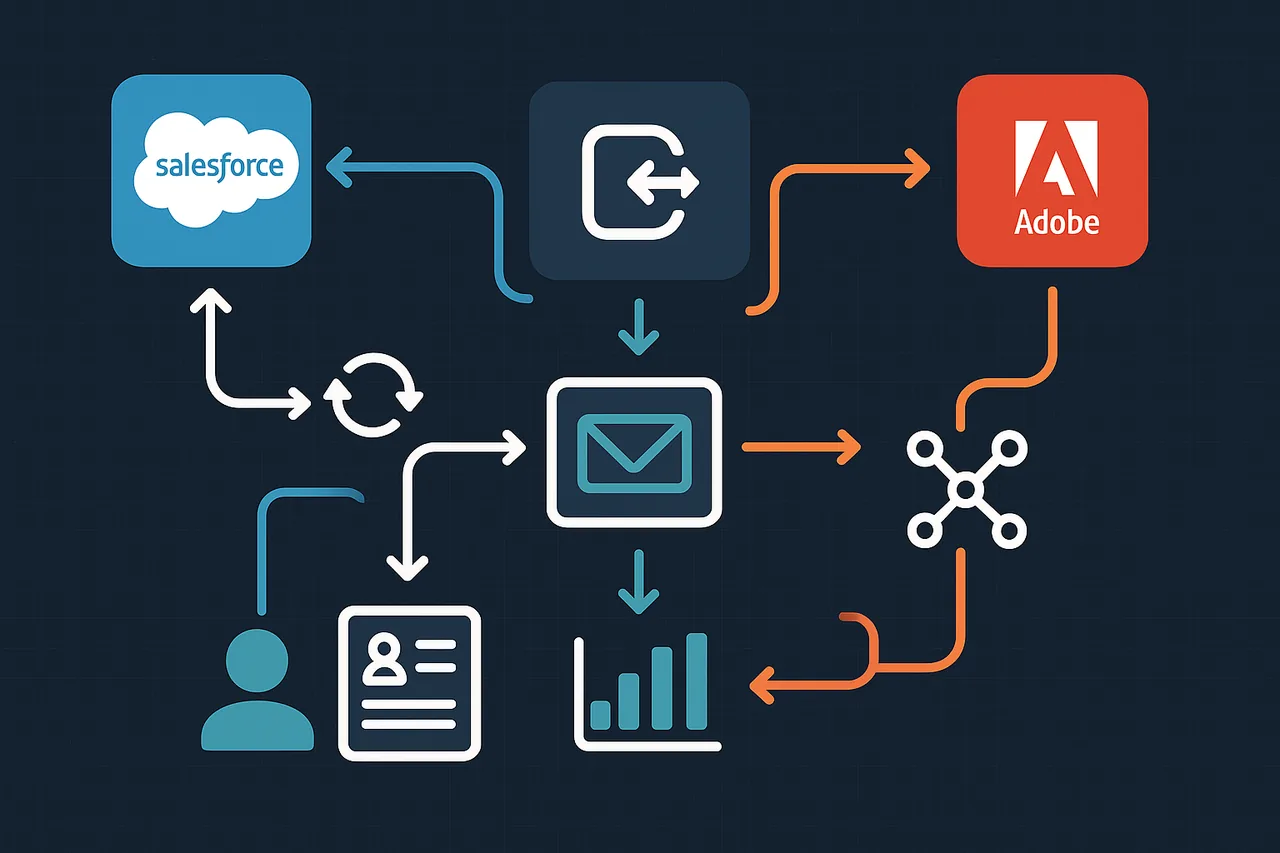
CRM and marketing-data integration connects the records and events behind acquisition, nurture, qualification, and sales follow-up. On Beat Digital maps identity, fields, lifecycle rules, and data movement across Eloqua, Salesforce, event capture, and enterprise sources.
A lead handoff can fail even when both platforms are working. The wrong identifier, an unmapped field, an unclear qualification rule, or a duplicate record can break the business process. We make that process explicit before connecting more systems.
Relevant experience
Our published work includes iCapture-to-Eloqua lead capture, Eloqua scoring and nurture, and Salesforce routing. Enterprise data integration work also feeds customer and lifecycle context into Eloqua Custom Data Objects for segmentation and activation.
Define the lifecycle and record relationships
We establish how the business identifies a person, a company, an event interaction, a qualified lead, and an opportunity. Those entities need a deliberate mapping across the platforms that create, enrich, and act on them.
The specification includes field ownership, required values, source identifiers, status transitions, and the conditions for a handoff. Not every field should synchronize in both directions. Direction and authority are chosen for the workflow rather than assumed from the presence of two APIs.
Event capture, qualification, and routing
Trade shows and other events generate interactions that need validation and context. We connect event capture to form processing, scoring, nurture, and CRM routing so the receiving team has a usable record and an understandable next step.
iCapture is part of our published implementation history. Other event sources, including Lodago data, can be scoped around available records, export or API access, event identifiers, and the fields required for the agreed follow-up process.
Eloqua Custom Data Objects and audience activation
CDOs can hold information beyond standard contact and account fields and connect that information to segmentation and campaigns. They are useful when the marketing question depends on related records such as products, contracts, equipment, or event activity.
We define the relationship, field mapping, refresh pattern, and activation rule. The dataset needs to preserve enough context to explain why a contact qualifies for an audience and what should happen when source information changes.
Validate both movement and business outcome
We check whether records were extracted, accepted, associated, and made available to the intended workflow. A successful export is not proof that a salesperson received a correctly qualified lead or that the campaign used the latest source value.
The operating handoff should identify exceptions, duplicate handling, retries, and the team responsible for investigation. Reporting can then connect stage movement with the implementation evidence rather than treating synchronization as a black box.
What an engagement can deliver
- Lifecycle and identity map
- Business entities, stage definitions, and cross-system relationships.
- Field and direction contract
- Source ownership, mapping, required fields, and synchronization rules.
- Activation workflow
- Validated routing, CDO, scoring, or campaign handoffs.
- Reconciliation and exceptions
- Evidence of accepted records and a practical path for resolving failures.
Questions & answers
Can you connect Eloqua and Salesforce?
Yes. Our work includes lead routing, field mapping, lifecycle logic, and enterprise data handoffs involving Eloqua and Salesforce. The direction and scope of each connection are explicitly defined.
Is every integration bidirectional?
No. Some workflows ingest information for analysis; others create or update destination records. We define the direction, source authority, permissions, and acceptance criteria for each connection.
Can you connect event data to lead follow-up?
Yes. Our published iCapture and Eloqua work is one example. Additional event sources are assessed for their available records and access methods before the integration is scoped.